Trigonometry
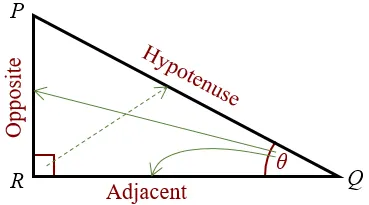
Opposite = height Hypotenuse = diagonal Adjacent = flat line = angle degrees
Sine & Arcsin
- What it finds: The Height (Vertical).
- Use this when you know the Diagonal length and the angle.
- Real World Example: A kid is flying a kite. He let out 100 feet of string (Hypotenuse). The string is at a angle. How high is the kite?
- to find the Height, you move the Diagonal to the other side:
If you already have the hypotenuse and the opposite (vertical) side, you are usually trying to find one of two things: the Angle or the Adjacent (horizontal) side.
arcsin
Finding Adjacent
Cosine & Arccos
- What it finds: The Base (Horizontal/Flat line).
- Use this when you know the Diagonal length and want to know how far it travels along the ground.
- Real World Example: A 12-foot ladder is leaning against a wall at a angle from the ground. How far is the base of the ladder from the wall?
Arccos
Tangent & Arctan
- What it finds: The Height (if you don’t have the diagonal).
- Use this when you are standing on the ground and looking up at something tall.
- Real World Example: You are standing 50 feet away from a tree. You look at the top at a angle. How tall is the tree?
Arctan or
- It finds the Angle of elevation or depression.
- Use this when you have the width and height, but no diagonal.
- Example: You are building a wheelchair ramp. The ramp must rise 2 feet (Opposite) over a horizontal distance of 24 feet (Adjacent). What is the angle of the ramp? \tan(\theta) = \frac{2}{24} = 0.0833$$$$\theta = \arctan(0.0833)$$$$\theta \approx \mathbf{4.76^\circ}
Unit circle
Because it is a circle with radius , its equation is derived from the Pythagorean theorem:
Because the Hypotenuse () is 1, the SOH CAH TOA formulas turn into direct values:
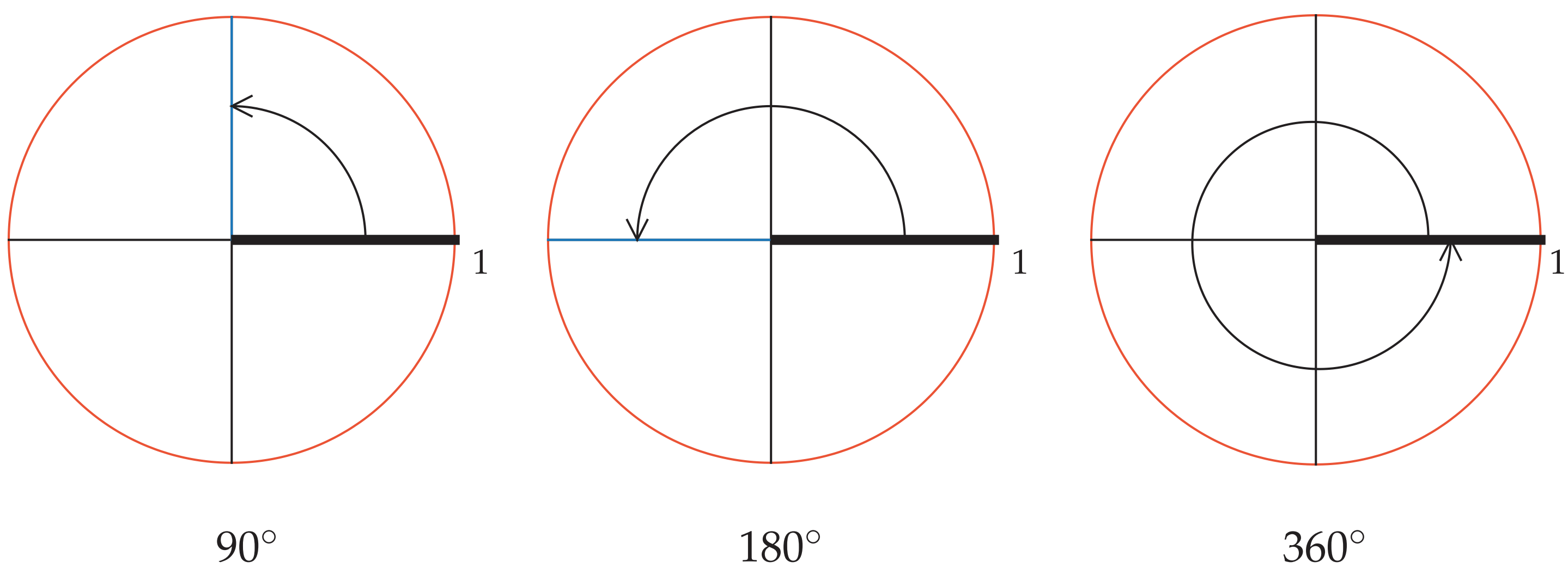
The radius ending at (0, 1) on the positive vertical axis has a 90 degrees angle with the positive horizontal axis.
Radian
radian is a measurement of the angle (the “opening” between two lines
Arc length
Arc length is the distance along the curved edge (the “crust” of the pizza slice).
Coterminal Angle
Keep subtracting full circles () until we get a number we recognize between and .
- First Lap: (Still bigger than a circle).
- Second Lap: .
Reference Angle
How far is the angle from the x-axis?
| Where is your angle? | The Formula | Logic |
|---|---|---|
| Q1 (-) | No formula needed. | The angle is its own reference! |
| Q2 (-) | How many degrees before the line? | |
| Q3 (-) | How many degrees past the line? | |
| Q4 (-) | How many degrees until the line? |
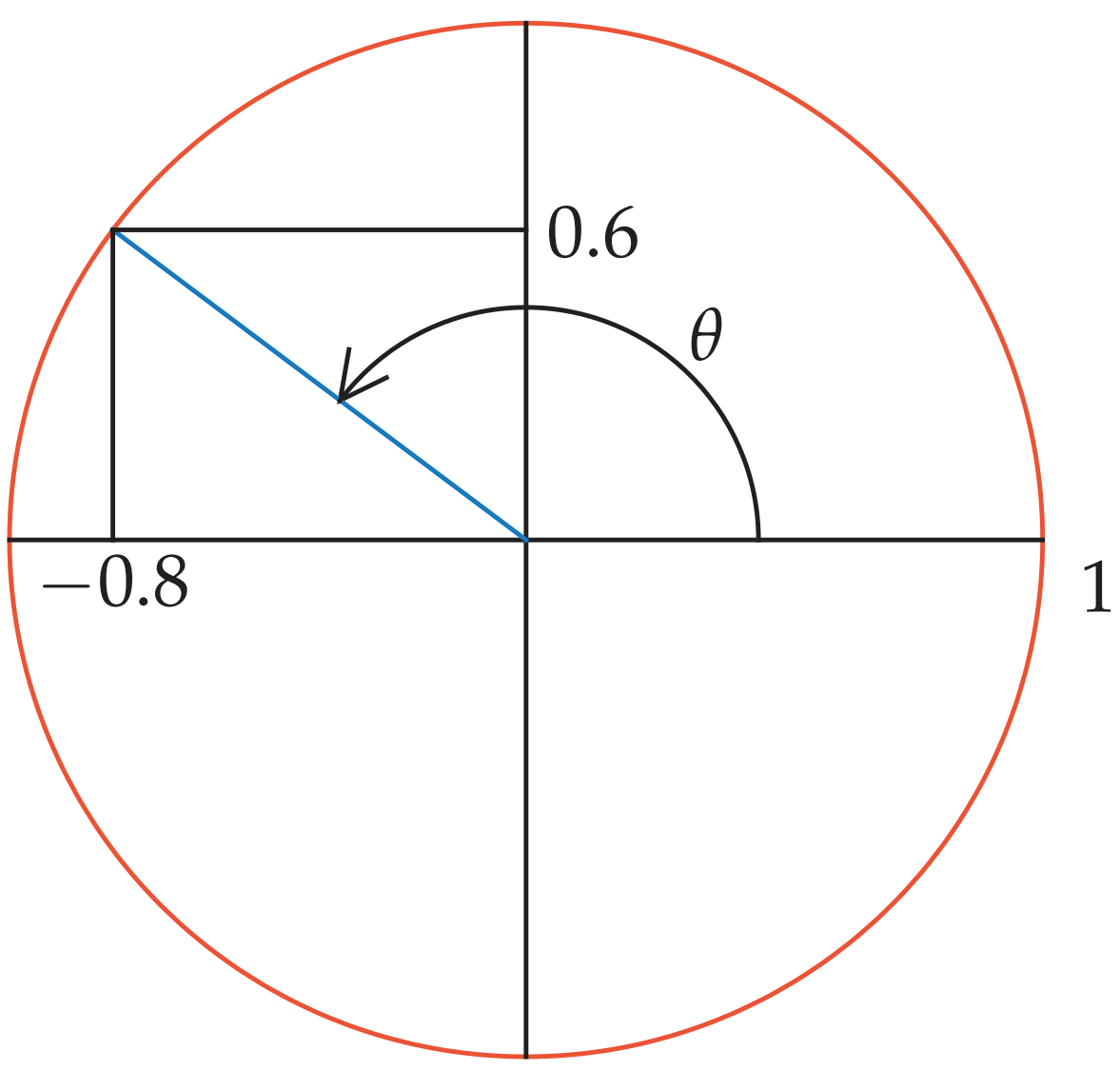
The “Height”: . This tells us that the point on the unit circle is exactly units above the center line.
The “Location”: . This tells us the angle is between and . Looking at the circle, this means the point is in the top-left section (Quadrant II).
Since it’s a unit circle, we know the Hypotenuse is 1. As we discussed earlier, every point must follow the rule .
Because is and is , the problem uses this formula:
- .
- .
- , which equals .
- To find , you take the square root of . This gives you two possible answers: or .
Trigonometric Functions of Real Numbers
On the unit circle, the primary functions are defined as:
- Sine:
- Cosine:
- Tangent: (where )
Reciprocal Trigonometric Formulas
These functions are the “flipped” versions of the primary ones:
- Cosecant: (where )
- Secant: (where )
- Cotangent: (where )

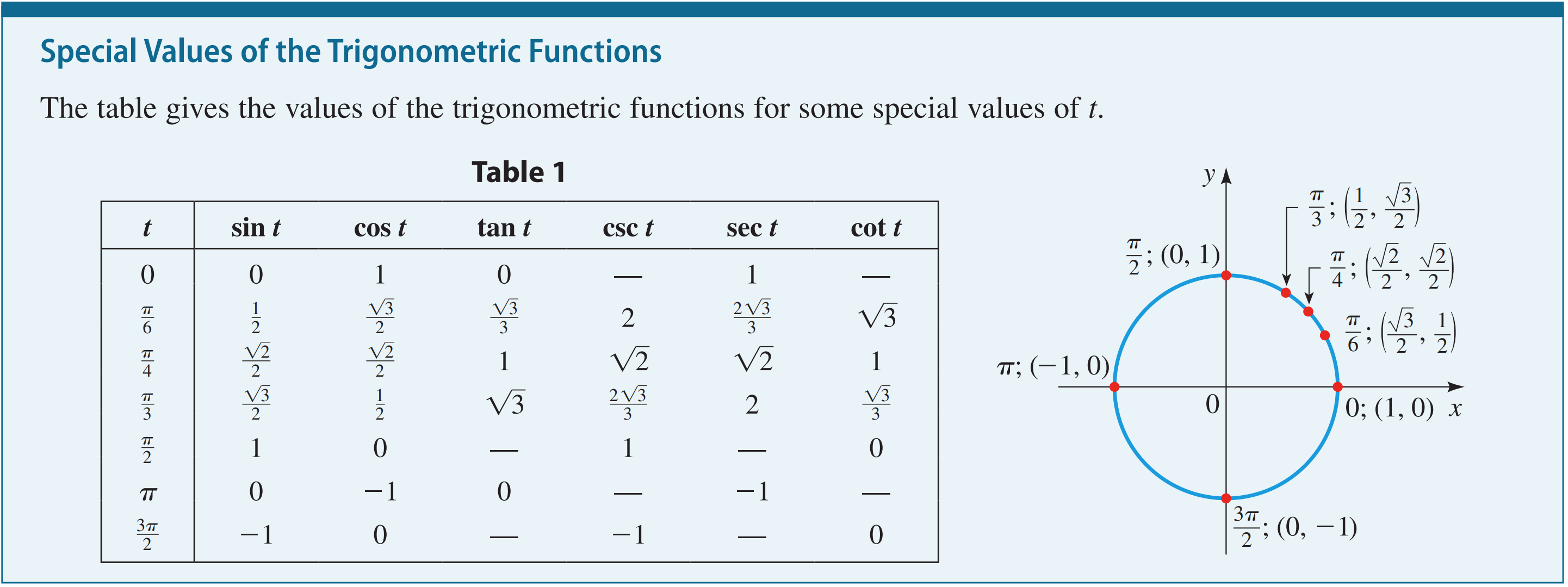
Domain of trigonometric function
imagine a “laser pointer” rotating from the center of the circle, there are two specific moments where the Tangent or other value simply doesn’t exist.
| Function | Domain (Input) | Range (Output) |
|---|---|---|
| All Real Numbers | ||
| All Real Numbers | ||
| All (Odd multiples of ) | ||
| All (Multiples of ) | ||
| All (Odd multiples of ) | ||
| All (Multiples of ) |
Remember that Tangent is the ratio of Vertical () to Horizontal ():
As you rotate the radius, you are building that rectangle we talked about earlier.
At (The top edge): Your point is at . The horizontal width () is zero.
The Math: .
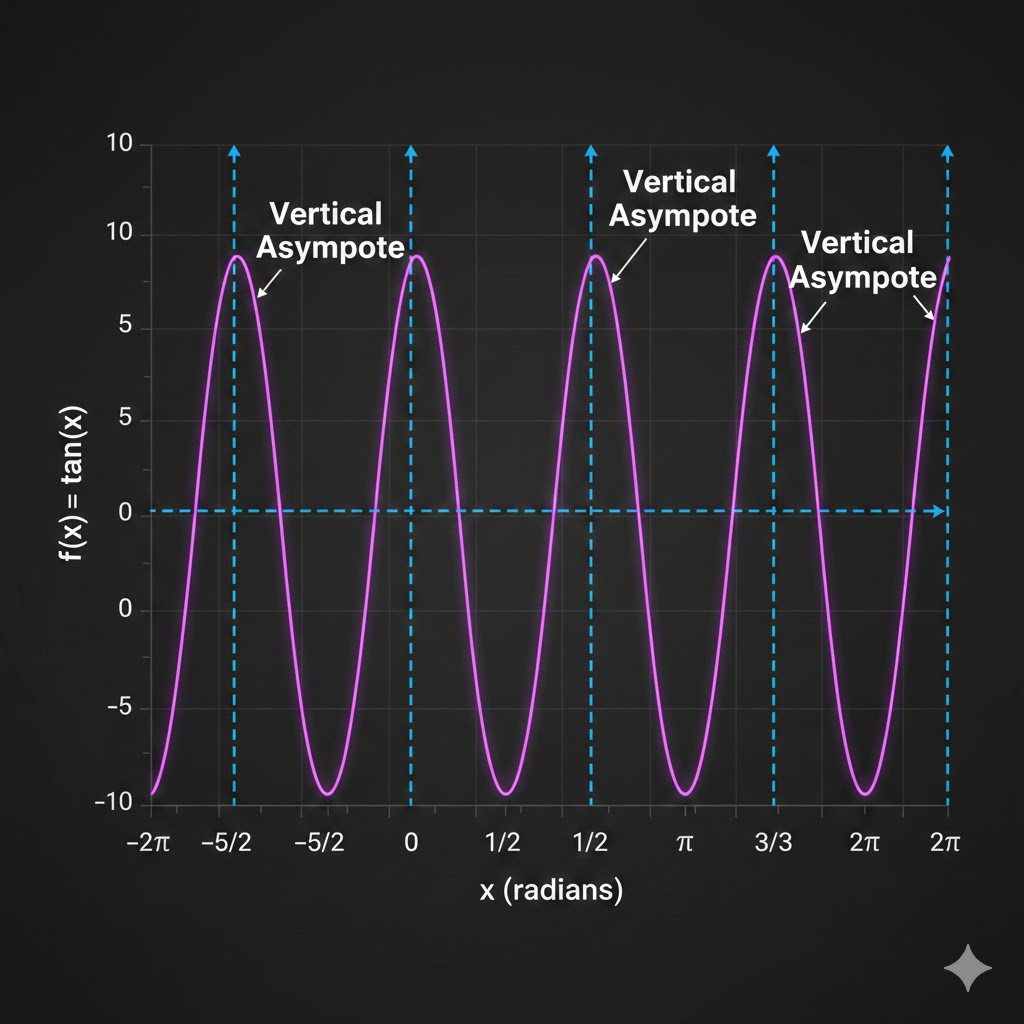
you cannot divide by zero. At this exact angle, the Tangent “breaks” and becomes undefined.
https://www.desmos.com/calculator/ajd5qthpcw
Cosecant
(The flip of Sine)
- What it finds: The Diagonal length.
- Use this when you know how high you need to go and want to find the diagonal path.
- Real World Example: You want to build a zip-line. The platform is 20 feet high. You want the line at a angle. How much cable do you need to buy? (Note: is )
Secant
(The flip of Cosine)
- What it finds: The Diagonal length.
- Use this when you know the flat distance and need to find the diagonal.
- Real World Example: An architect is designing a bridge. The gap to cross is 100 feet wide. The support beam must be at a angle. How long is the beam? \text{Beam} = 100 \times \sec(30^\circ)$$$$100 \times 1.15 = \mathbf{115 \text{ feet long}}
Cotangent
(The flip of Tangent)
- What it finds: The Flat distance.
- Use this when you know the Height and want to find the ground distance.
- Real World Example: A lighthouse is 100 feet tall. It spots a boat at a angle from the top. How far away is the boat on the water? The Answer:
Transformation of Trigonometric Functions
The standard sine wave can be stretched, squished, and moved. The general formula is:
Amplitude ()
- What it does: Vertical Stretch.
- Visual: Controls the height of the wave peaks.
- Physics: In sound, this is Volume (Loudness).
- Formula: is the distance from the center line to the peak.
Period ()
- What it does: Horizontal Squish/Stretch.
- Visual: How fast the wave repeats.
- Physics: In sound, this is Frequency (Pitch). High = High Pitch.
- Formula: The new Period is .
Phase Shift ()
- What it does: Horizontal Shift.
- Visual: Moving the start of the wave Left or Right.
- Physics: This is Timing. (e.g., Does the sound start now, or 1 second later?)
Vertical Shift ()
- What it does: Vertical Shift.
- Visual: Moving the entire wave Up or Down.
- Math: It changes the “center line” (midline) of the oscillation.
Example:
- Amplitude: 3 (The wave goes 3 units up and down from the center).
- Period: (It oscillates twice as fast as normal).
- Phase Shift: Right by .
- Vertical Shift: Up 5 (The center line is now at ).
The Law of Sines and the Law of Cosines
These two laws allow you to solve triangles that are not right-angled triangles (Oblique Triangles).
The Law of Sines
Use this when you know a “pair” (an angle and the side opposite to it) and one other piece of information.
Two fire towers are 10 miles apart. Tower A spots a fire at a angle. Tower B spots the fire at a angle. How far is the fire from Tower A?
- Find the third angle: (Angle C).
- Set up the ratio:
- Solve: .
The Law of Cosines
Use this when you don’t have a matching pair. Usually when you have SSS (Side-Side-Side) or SAS (Side-Angle-Side). This is basically the Pythagorean Theorem adjusted for non-90-degree angles.
Real World Example: You walk 3 miles North, turn , and walk 4 miles. How far are you from your starting point?
Identities
Use identities to rewrite complex expressions in a simpler form
Reciprocal and Quotient Identities
These define how the six functions relate to one another:
Quotient: and Reciprocal: \csc(\theta) = \frac{1}{\sin(\theta)}$$$$\sec(\theta) = \frac{1}{\cos(\theta)}and
Pythagorean Identities
Based on the Pythagorean theorem () applied to the unit circle:
example
First, we use basic algebra to expand the squared part :
Now, put that back into the full equation:
- Notice and a . They cancel each other out completely.
- Pythagorean Identity: You are left with . As we know from the fundamental identity, this always equals 1.
Result:
Beyond the basics, there are several dozen “advanced” identities used in calculus, physics, and complex engineering:
- Even/Odd Identities (6): Based on the symmetry of the circle (e.g., ).
- Cofunction Identities (6): Relating sines to cosines of complementary angles (e.g., ).
- Sum and Difference (6): Formulas for , etc.
- Double-Angle (5+): Formulas for , , and .
- Half-Angle (3): Formulas for , etc.
- Product-to-Sum & Sum-to-Product (8): Used heavily in audio and signal processing.
Inverse Identities
Composition Identities (Undoing the function)
If you take the Sine of an Arcsine, they cancel out, leaving just the number.
Complementary Identities
Since the two non-right angles in a right triangle always add up to radians, their inverse functions are linked.
Negative Argument Identities
What happens if you plug a negative number into the inverse?
- (The negative moves outside)
- (The negative moves outside)
- (Special Case: You must subtract from 180 degrees)
Addition and Subtraction Formulas
These allow you to calculate the sine or cosine of a sum of two angles. This is useful for finding the exact value of angles like (which is just ).
The Formulas
- Sine:
- Cosine: (Remember: signs flip!)
- Tangent:
Double-Angle and Half-Angle Formulas
These are used to simplify calculus problems or calculate exact values for angles without a calculator.
Double-Angle Formulas
Used to find the value of when you know .
Sine: Cosine: Alt form: Alt form: Tangent:
Half-Angle Formulas
Used to find the value of when you know . The depends on which quadrant the new half-angle lands in.
- Sine:
- Cosine:
- Tangent: